





Read news
Add bookmark
POPULAR
Oil? Gas? Fertilizer? Just Life.Regular Ones Made IrregularMigrant Workers and Farming Will They Get a Decent Living and Employment?Labor of Migrant Workers in Agriculture The Cases of Five Entirely Different CountriesOn Externalization of Asylum, with Responsibility Offloaded to Third CountriesEurope in the Age of GeoeconomicsPacifism Gives Way to Voluntary Military Service What Does Germany Need It For?Circular Migration in Spain Strengths and Weaknesses of the Spanish Migration Model
There is a so-called circular migration programme (also known as collective migration) that has been used in Spain for many years. Officially it is called Gestión Colectiva de las contrataciones en Origen (Collective Management of Recruitment at Origin) or GECCO. The programme is often presented as an advanced one. The European Commission even took the “Spanish model” as the basis for drawing up the EU’s directive on seasonal workers.
However, the question whether the GECCO programme can be an example for using other countries remains open. There are obvious disadvantages to this programme as well.
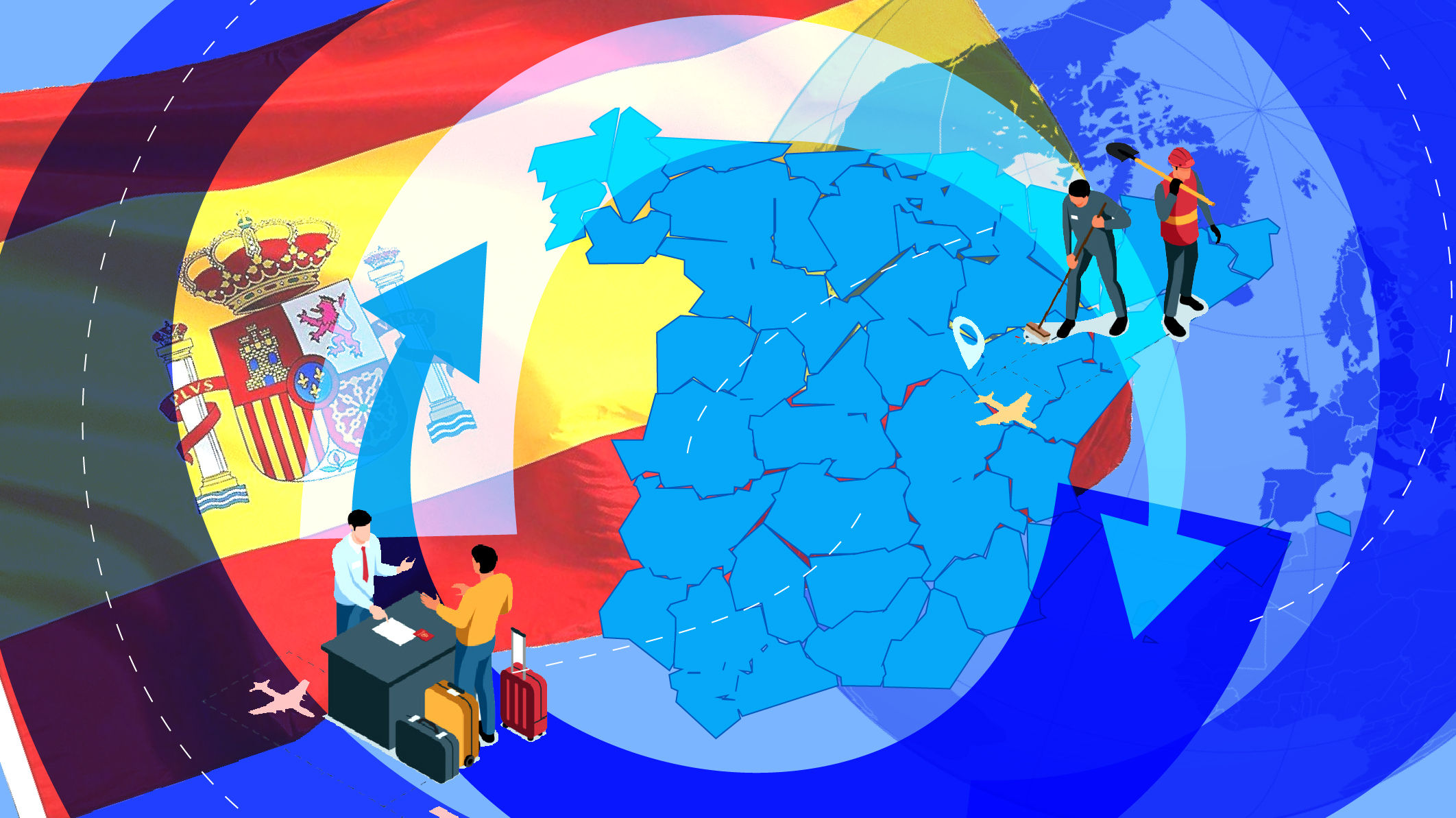
The program has been in use for a quarter of a century now. Its main point is quite simple. If employers in Spain fail to fill a vacancy in the domestic labour market, they are permitted to recruit migrant workers in their countries of origin. With that, the employer is responsible for handling the visas for the migrant workers to enter the country. The employer must also organise the journey and cover the cost of the return ticket as well as provide workers with decent accommodation.
For migrant workers who may find themselves in a difficult situation in their countries, the circular migration programme promises a much higher salary than what they could get at home. The programme also allows travelling back and forth between countries, which is sometimes difficult in a conventional migration situation (with temporary permits).
Moreover, the fact that the residency permit is tied to a certain employer provides a relative guarantee that workers do not escape to other, better-paid sectors.
The workers must return to their country of origin when the work contract ends. Failure to comply with this requirement will result in denial of future work permits. Workers who do fulfill these obligations have priority in future recruitment campaigns.
At the same time, the programme has a number of significant disadvantages. For migrant workers, their stay in the country is temporary. They cannot remain there any longer than the time stipulated in the contract. Overstaying their visa and a breach of the obligation to return home means moving into illegal status. Reliance on employers, on whom the residence permit and the chance of coming back depend, in practice limits a worker’s ability to report mistreatment. Another significant problem is the fact that in the agricultural sector where most migrant workers work, working hours are not fixed but rather depend on needs and the weather. It means the days worked and, therefore, the level of income is not established beforehand.
Ultimately, even though the GECCO programme has a lot of advantages it also has a number of significant disadvantages. They have to be eliminated.
For example, it is necessary to raise the seasonal workers’ awareness by providing information on the conditions in their contracts and their rights prior to departure and after. Training programmes should be improved, also at origin and with regard to the language.
Finally, it is necessary to improve the conditions for the workers no matter how deprived of their rights they can be. it should be made easier to work successive contracts with different employers in different regions. To prevent dependence on one employer curtailing a worker’s capacity to report possible abuses, it should be made easier to switch employers.
Without resolving these simple but extremely serious issues, any transfer of the Spanish experience to other EU countries will bring more damage than benefit. If the GECCO programme is transferred to other countries, there is a risk that its internal contradictions often hidden behind the cover will end up becoming insoluble.