World Center for Strategic Studies
From closed analysis to public debate

- MONTH
- YEAR

Europe’s Clean Tech Trap: China Builds, Europe Watches
The analysis exposes an uncomfortable truth behind Europe’s green ambitions – the clean tech transition is increasingly being powered, shaped and captured by Chinese joint ventures on European soil. What is sold as cooperation and investment masks a deeper loss of control. The piece argues that Europe is repeating an old mistake: welcoming foreign capital to fix industrial weakness, then realising too late who owns the future.
At its core, the study says Europe’s clean tech push rests on fragile foundations. Lacking scale, capital and speed, European firms turn to Chinese partners to build batteries, solar panels and electric vehicle components. These partnerships deliver factories and jobs quickly, but also lock Europe into asymmetric relationships where technology, supply chains and strategic decisions drift out of European hands.
Speed beats sovereignty
Chinese firms move faster and invest bigger. The analysis shows how their ability to deploy capital and technology at scale gives them the upper hand in joint ventures, even when projects are located inside the EU.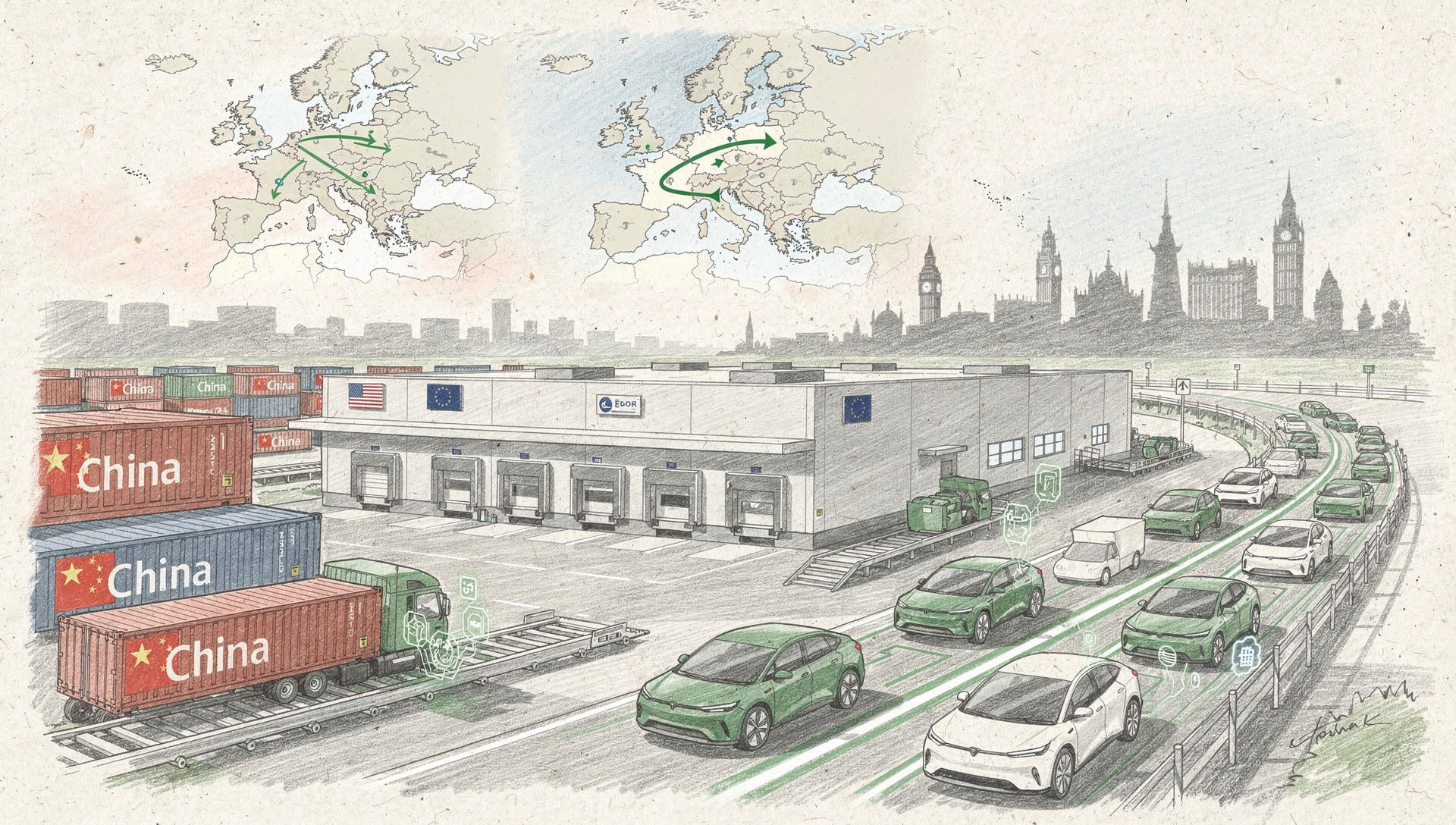
Joint ventures, unequal terms
On paper, partnerships look balanced. In practice, the study highlights how Chinese players retain control over key technologies, upstream inputs and production know-how. Europe hosts the plants, China keeps the leverage.
Industrial policy arrives too late
Europe talks about strategic autonomy after the fact. The analysis argues that weak coordination, slow permitting and fragmented funding leave European actors dependent on external partners just to stay in the race.
Green goals collide with power politics
Climate urgency pushes governments to accept deals they would otherwise question. The paper frames this as a vulnerability – decarbonisation becomes a shortcut for strategic compromise.
Supply chains stay Chinese
Even when production moves to Europe, critical components and raw materials still come from China. The analysis stresses that localisation without upstream control does not equal resilience.
Rules struggle to keep up
Screening tools and competition policy lag behind reality. The study warns that by the time concerns surface, dependence is already baked in.
The big warning: Green transition without control is dependency
Europe risks swapping fossil reliance for clean tech subordination.
If Europe keeps outsourcing speed and scale to China, it will decarbonise faster but govern less. The clean tech race will be won on European territory, but not on European terms – and by the time that becomes obvious, reversing it will be brutally hard.