





Read news
Add bookmark
POPULAR
Oil? Gas? Fertilizer? Just Life.Better Regulation in the European Union Needs a Fresh StartAn Illusion of Managed Interdependence. A Transatlantic Tech PartnershipGermany Balks at Palantir: Data Sovereignty Put Before Military AICatching Up: Europe’s Path to Strategic Autonomy in the Defense IndustryDemocracy in Europe: protection or reinvention How now will the continent live?EU - China Relations: Role of the European Commission in Forming Strategic ProspectsAI’s Impact on Military Intelligence and Decision-Making The Simulacrum of Normative Power
A report by Sofia Romansky, a strategic analyst at The Hague Centre for Strategic Studies (HCSS), assesses the influence of AI on the military domain. According to the author, the acceleration provided by AI will be a crucial decision-making advantage for commanders in the battlefield. The author examines the accompanying challenges posed by the technology: moral disengagement, automation bias, and the need for international regulation. In the last-mentioned field, the author pins special hopes on Europe as the ‘normative leader’. However, this ethical rhetoric hides a far more disturbing reality for the Europeans in which all such prospects break against the EU’s technological and political dependence that the author glosses over.
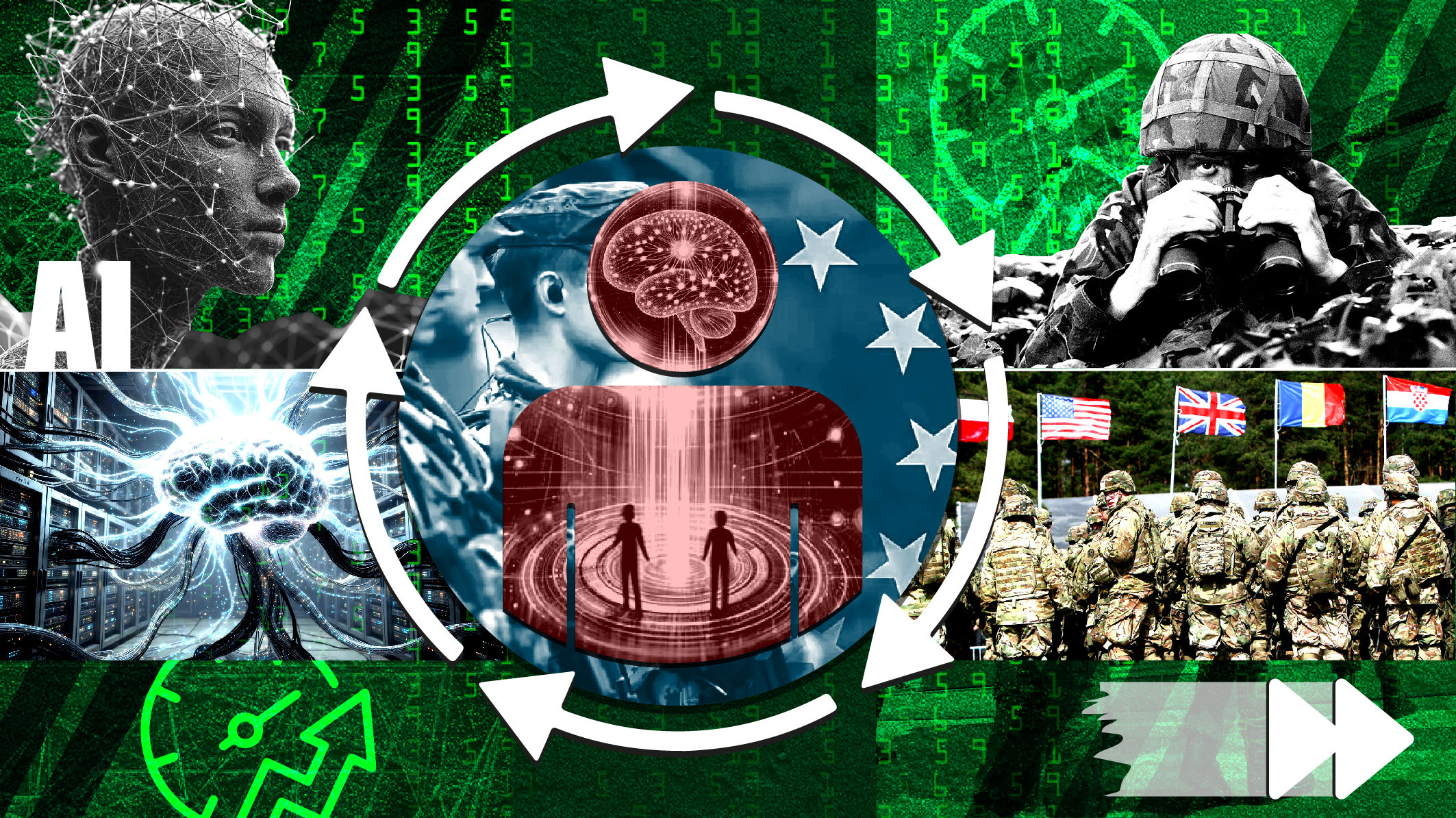
The text examines the AI military advantage in detail and concentrates on the so-called OODA (Observe, Orient, Decide, Act) Loop. At the observation stage, AI processes more intelligence data than any human ever could. At the orientation stage, it analyzes the information gathered to create a strategic design. At the decision stage, AI predicts outcomes and helps avoid errors. At the action stage, the system controls maneuvers and drones directly, ahead of human responses. The author cites the example of the Ukrainian war where AI is used for target identification and situational awareness on a daily basis. Yet, completely focused on the idea that speed is victory, the author overlooks the fact that such acceleration leads to European armies’ inevitable dependence on imported technology. The algorithms created in the USA or China remain ‘black boxes’ unavailable for inspection. The experience of actual combat use in Ukraine belongs to Palantir, an American company. Even the few European defense AI developers (Helsing and Mistral) lack their competitors’ resource base and depend critically on international chip supplies.
.jpg)
The global AI competition is mainly between the US and China, but the author believes it is the EU that should spearhead international governance, referring to the fact that the USA is dominated by a private sector not interested in any regulation, while China is an autocratic and non-transparent State. And the EU, not dependent on the Silicon Valley’s profit margins or on authoritarian control, can promote ethical standards and international law. She mentions the GC REAIM (Global Commission on Responsible AI in the Military Domain) initiative that the author herself coordinates and proposes as an inter-State cooperation forum. Behind this noble call there appears to be an attempt to fill the technology gap with bureaucratic activity. The real players are the USA (with USD 680 billion investment in 2023) и China (with 150 billion). Fora like GC REAIM can count on no more than formal participation by leading nations. Neither the USA nor China have acceded to the February GC REAIM declaration; the key actors continue their arms race without looking back at Brussels.
The report creates the illusion that Europe may win if it sets its own rules. Yet Europe accounts for a mere 5% of global computing capacity and 6% of venture investment in AI, while the cloud infrastructure belongs to U.S. giants (an AWS outage even paralyzed the EU institutions in October 2025). Its only tool, the ASML company with its lithography equipment monopoly, remains unused due to fears of hitting its own industry giants. Institutions like the ECHR are themselves in crisis. In December 2025, 27 Council of Europe member countries sought an altered interpretation of the Convention to regain control over their borders. Europe has long since discredited itself as an honest broker when it comes to migration deals, climate hypocrisy, or reservations in arms supplies. Its calls for an ethical AI are perceived not as a reference point to follow but as rhetoric of a weak party trying to make up for its lack of power. Europe’s last remaining privilege is to watch others catering to its security and to hope that the ‘digital blockade’ will never be activated.