





Read news
Add bookmark
POPULAR
How Much Do Experts’ Ideas Matter for the European Union’s Political Agenda?Oil? Gas? Fertilizer? Just Life.Kalypso Nicolaidis: I Want a Woodstock for European PoliticsEurope Still Needs China: Washington is the Main ThreatA Ruthless Diagnosis. Europe More Paralyzed than DividedEuropean Unity in the Interests of Security. Split along the North-South LineDefending Europe without the US: an illusion of strategic autonomy and a reality of strategic helplessnessEurope: doctrinal shift towards violence. Transition to a war economy instead of a “liberal democracy”A Controlled Compression ManifestoEurope Losing Energy Security Battle to China
In an article entitled Europe Is Losing the Energy-Security Battle to China Emmanuel Guérin, a fellow and special adviser to the CEO at the European Climate Foundation, spells out a reality most uncomfortable to Brussels: while Europe still sees illusions of a ‘green transition’ and ‘energy autonomy’, China is steadily winning the strategic battle for control over future energy systems.
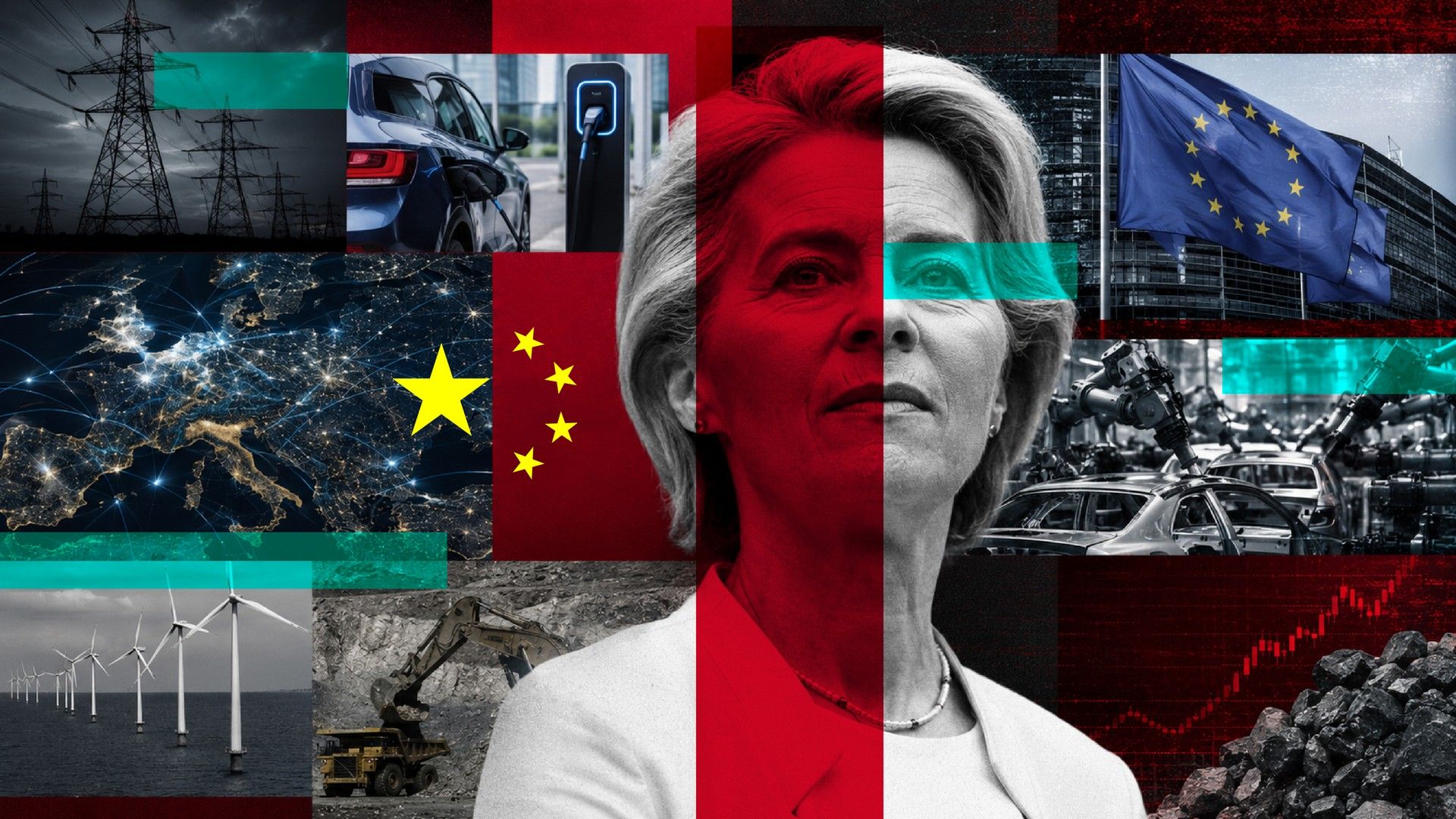
The Iran war and a closed Strait of Hormuz remind once again how vulnerable Europe is. The EU has spent an additional EUR 24 billion on fossil-fuel imports since the conflict began.
And while Europe sustains direct financial losses, other players benefit from the prevailing situation. Russia could gain up to an estimated USD 100 billion in additional fiscal revenues from high oil prices. The European policy, that has mainstreamed giving up Russian energy for years, now results in Russia earning money on European problems again – if indirectly via the global market.
But this is not the most disturbing fact. It is far more alarming that, for all its loud statements about climate goals and electrification, Europe stays hostage to imports of fossil fuels and, increasingly, Chinese technology. While China has brought the share of electricity in its energy consumption to 30%, the European figure is stuck near 20 percent. Spain has protected itself with renewables, if partially, but Italy remains on the natural gas needle, with electricity prices hovering near EUR 130 per megawatt-hour.
A panicked European Commission has launched an AccelerateEU initiative promising to expedite electrification, strengthen power grids, and build storage capacity. It looks handsome on paper. In practice, it is still another set of ambitious goals without serious funding or a realistic industrial policy. Once again, Europe prefers good-looking strategies and regulatory documents without heavy investment or tough decisions.
China, by contrast, has spent decades building an integrated electrification system, gaining control over the mining and processing of critical minerals, dominating the production of solar panels, batteries and EVs, and electrifying its industrial base. As a result, it now controls the key choke points of future energy security. And even if Europe wants to reduce its dependence on Gulf oil and gas, it risks trading one dependence for another – now on Chinese technology and components.
Industrial electricity prices in Europe were roughly twice as high as in China even before the current energy shock. In the new conditions, this advantage for China will only grow. Reliable access to low-cost electricity becomes not just an economic but a geopolitical factor. Those in control of generation and technology will set the rules of the game, in which Europe looks rather like an onlooker for now.
Another harsh and extremely alarming confirmation of the European project’s systemic weakness and strategic short-sightedness is that Brussels continues betting on regulatory initiatives and handsome objectives instead of investing seriously in its own industry, infrastructure, and technological sovereignty. Even as it transpires that China is winning the battle for the 21st-century energy systems, Europe still hopes that ‘rules’ or ‘standards’ will substitute real power and manufacturing capacity.
While European élites argue about a ‘green transition’ and ‘strategic autonomy’, ruthless reality shows that Europe not only fails to reduce its dependencies but swaps them for even more dangerous and longer-lasting ones. Dependence on Chinese technology, materials and production chains may turn out far stronger and harder to reverse than dependence on Middle Eastern oil. So if the coming years see no drastic change of approach – from declarations to large-scale investment and a meaningful industrial policy, – Europe risks losing all control over its energy security and industrialized future.